If you’ve looked at a Google Ads Search Term Report (STR) lately, you know it feels like stepping off a merry-go-round a little too fast. The tidy lists of “best running shoes” or “mortgage rates NYC” that we built entire careers around? Those are fading out. Now, it’s a wall of text that sounds like someone rambling into their phone while driving. You see stuff like: “Hey, find me that blue sneaker brand I saw on TikTok, the one with the extra arch support because my left foot has been killing me lately.”
This article explores the fundamental shift from syntax to semantics. We are moving beyond simple keyword matching and into the era of Natural Language Processing, where the length, tone and even the phonic urgency of a spoken query dictate your ad spend.
Welcome to 2026. Voice search isn’t just bigger, it’s completely transformed the STR into a chaotic transcript of people thinking out loud. For those of us working inside agencies, this isn’t just some formatting headache; it’s a real change in how we track intent, protect budgets, and, honestly, just stop wasting our clients’ money.
1. The “Conversational Bloat” of 2026 in Google Voice Search Ads
Remember back in 2022? Search queries averaged about 2.8 words. Now? Nine. Sometimes ten. Thanks to Gemini Live, the new Siri LLM, and everyone chatting with smart glasses, search queries have gotten long-winded. This messes with your account in two ways:
Intent gets lost: If someone types “plumber,” you know exactly what they want. But if they say, “Hey Google, I think my water heater is making a weird clicking sound, should I call someone or just wait?”—good luck figuring out what they actually want. Intent is buried under a pile of words.
The “close variant” minefield: Google’s close variant matching is in overdrive. It tries to connect a 15-word spoken query to your simple [Plumber] keyword. If you’re not careful, you end up paying for clicks from people who are just musing aloud—not ready to buy.
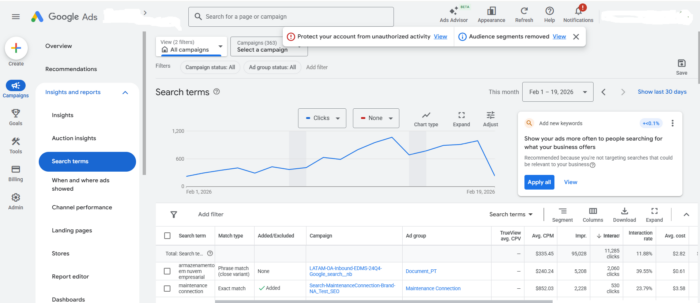
If you’re wondering how to find the search term report in Google Ads to check this yourself, head to Insights and Reports → Search Terms. Pull data weekly. In a voice-heavy account, this report changes fast.
2. “Ambient Intent” and the Ghost in the Machine
Here’s the most annoying change: accidental voice triggers. With always-on wearables, the STR is picking up background noise—random snippets of conversation that aren’t real searches.
We’re seeing a jump in what we call Low-Confidence Matches. The AI thinks it heard someone searching, but it just caught chatter from a phone sitting on a kitchen counter.
What does this mean for you? Time to get serious about your Negative Keyword Scripts. If 40% of your STR is “Hey Google” and “I was wondering,” you’re pouring money down the drain on junk queries. We’ve started blocking “politeness markers” like “please,” “thanks,” and “can you.” They’re not bad words; they’re just clutter, hiding the real intent we need.
3. Sentiment is the New “Keyword”
For the first time, how people talk tells us more than what they actually say. In 2026, we’re sorting STRs by Phonic Urgency.
The “Panic” Query: “Siri, I need a locksmith NOW, I’m locked out and my oven is on!” (Expensive click, but high chance they’ll convert.)
The “Boredom” Query: “Hey, what are some cool places to go on a Saturday if it’s raining?” (Cheap click, but they bounce fast.)
If you’re bidding the same amount for both, just because they include “places” or “locksmith,” you’re missing the point. We have to organize campaigns by “Problem-State” instead of just “Topic-State.”
Topic State: You bid on the noun. For example, bidding on “locksmith” regardless of why the user is searching.
Problem State: You bid on the situation revealed by the voice transcription. The AI analyzes the phonic urgency and context to determine the level of immediate need.
4. The “Entity” Crisis: Brand Names Are Fading
Here’s a stat to scare your brand clients: branded search volume is dropping for mid-sized companies.
In 2026, people don’t remember names they remember little details. Instead of “Allbirds,” they’re telling their AI, “those sustainable wool shoes you don’t have to wear socks with.”
If you work for a brand, your STR probably shows you’re winning auctions for these descriptions, not your actual name. Teams focusing on SEO for voice search and PPC teams have to work hand-in-hand. If your landing page doesn’t echo the exact language people use in the STR, your Quality Score tanks, because Google’s AI won’t see the match.
FAQs
What Are Voice Search Ads?
Voice search ads are paid search ads triggered by spoken queries on devices like smartphones, smart speakers, wearables, and AI assistants.
Instead of typing “best plumber near me,” users say something like, “Hey Google, who can fix a leaking pipe tonight?”
Google Ads treats these spoken queries as search intent. Your ads can appear in the results, just like traditional text searches. The difference? Voice queries are longer, more conversational, and often more urgent.
That shift changes how your keywords match, how your search term report looks, and how you manage negatives.
Are Google Voice Search Ads Different From Regular Search Ads?
Technically, no. Google doesn’t have a separate campaign type labeled “Google voice search ads.”
Voice queries simply feed into the same Google Ads system.
The difference shows up in the Search Term Report. Voice searches tend to be:
- Longer
- More conversational
- Framed as questions
- Filled with qualifiers and context
That means your match types, negative keywords, and bidding strategies need to adjust—even if your campaign structure stays the same.
What Is A Search Term Report In Google Ads?
The Search Term Report (STR) shows the actual queries users typed or spoke before clicking your ad.
Not your keywords.
The real phrases.
It’s where you see:
- What triggered your ads
- Whether the intent matches your offer
- Where you’re wasting budget
- Where new opportunities are hiding
In a voice-first world, this report matters more than ever. It’s no longer neat two-word phrases. It’s full conversations.
How To Find The Search Term Report In Google Ads?
Here’s how to find the Search Term Report in Google Ads:
- Log into your Google Ads account
- Click on “Campaigns”
- Select a specific campaign or ad group
- Click “Insights and Reports”
- Choose “Search Terms”
You’ll see the exact queries that triggered your ads.
If you’re running Performance Max, you’ll need to check insights reports, since full transparency isn’t always available.
And with voice search growing, reviewing this report weekly isn’t optional anymore.
Do Voice Search Ads Convert Better?
Voice queries often show higher intent. Someone saying, “I need an emergency dentist right now,” is in a very different mindset than someone typing “dentist.”
But voice traffic also includes exploratory and accidental queries. That’s why filtering your Search Term Report and tightening negatives is critical.
Intent matters more than volume.
The Bottom Line: Stop Fighting the Conversation
Voice search ads aren’t a separate campaign type, but they are reshaping how your Google Ads search term report behaves.
The Search Term Report isn’t broken. It’s finally showing us how people actually think. We’re not wired for keywords we think in problems, half-questions, and frantic requests while juggling groceries.
As agencies, we need to quit shoving users back into some tidy “keyword box.” Embrace the messiness of the 2026 STR. See it as a direct line into the consumer’s mind. If people are searching “How do I…”, for the love of ROAS, don’t send them to a “Buy Now” page.
The data’s talking. The only question is, are you actually listening or just hunting for keywords?