Online reputation management (ORM) is the practice of monitoring and improving (when necessary) how your brand is perceived on the internet. In practice, this means responding to negative reviews, suppressing negative search results or comments, and addressing any misinformation about your company.
There are a lot of misconceptions about online reputation management. Some people think it’s just social media monitoring, while others believe it has something to do with public relations, and still others have no idea the impact it can have on sales.
The truth is that online reputation management aligns most closely with digital public relations (PR) with a slight twist. Whereas digital PR focuses on proactively building your online brand, online reputation management focuses on protecting your online image.
When you look at the definition of ORM, it’s easy to see why it’s essential for businesses of all sizes. In today’s marketplace, where smartphones alone account for 80% of retail website visits, it’s safe to say that how you’re viewed online is critical to business success.
In this guide, I’ll explain the role of online reputation management in today’s digital age, explain why it matters, and outline six ways to improve your brand’s online image.
Key Takeaways
- Your online reputation is what shows up when people Google you. ORM is the act of monitoring mentions and reviews, responding fast, and making sure that accurate, trustworthy content dominates page one.
- Monitoring needs layers. Use Google Alerts for quick, free coverage, then add tools like Mention or Brand24 when you need more comprehensive monitoring across social, blogs, forums, and news, especially if volume is high.
- Reviews are a conversion lever. Treat them like support tickets. Respond the same day on high-visibility platforms like Google and Yelp. Stay calm, human, and non-defensive. Apologize when you’re at fault, and move it offline when back-and-forth is needed.
- You can’t delete most negative content, but you can outrank it. Suppression requires SEO, content, and distribution. Publish stronger assets (site pages, PR, profiles, testimonials) and promote them until they push negative content off page one.
- Make ORM a repeatable process. Assign owners for monitoring mentions, responding to reviews, and publishing positive content. Track KPIs monthly (ratings, review volume, sentiment), and address the underlying business issues driving complaints.
Why Does Online Reputation Management Matter Now More Than Ever?
20 years ago, the internet was very different. Companies didn’t engage customers; they just sold (or tried to sell) to a passive audience. People could not express their voices powerfully, and the overall communication landscape was very “top down.”
However, the situation has radically changed. Today, websites are no longer static brochures, and user-generated content is a must. Regular interactions on social networks are vital to a business’s success. This is becoming even more important as Google begins to highlight community forums like Reddit within AI Overviews at the top of search results pages (SERPs).
No matter the size of your business, people are talking about you, including prospects, customers, clients, and their friends. They are posting about your latest product or filming review videos for TikTok and Instagram.
If you think you can skimp on reputation management, or if you think you can succeed without listening to people’s voices, opinions, and reviews, think again.
Today’s Brands Must Be Transparent
One of the most important business commandments is “be transparent.” What does being “transparent” mean? Here are some examples:
- Allowing employees to talk about products and services publicly
- Establishing a one-to-one communication channel with your audience
- Asking for feedback from customers/your base
- Addressing criticism publicly rather than hiding it
That said, these tactics are easier said than done. Most small and medium-sized companies invest little in brand communication and struggle with this concept. As a result, their efforts are usually incorrect or inconsistent. Improving transparency across the board begins with building a consistent method to talk on behalf of your brand, then opening and monitoring channels where there may be discussion about the brand.
Online Reputation Management “Failures”
Being open does not come without a price. If you and your brand accept feedback, customer opinions, and so on, you must also be ready to address them promptly.
Consider these scenarios:
- What if your product/service sparks too much criticism?
- What if your employees are not social media savvy?
- What if your competitors take advantage of this?
These are just a few reasons you need a proper online reputation management plan in place before embarking on a transparency journey.
Here are four famous cases of reputation management failure in the digital era:
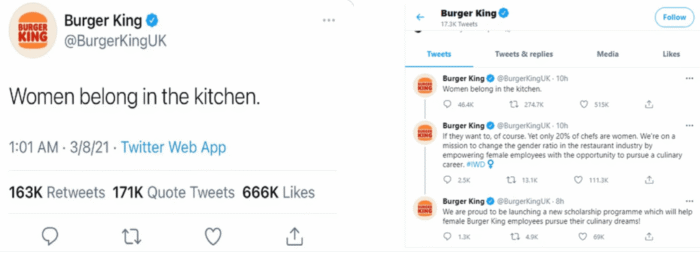
- Burger King UK’s “Women belong in the kitchen” commentary didn’t go off the way the brand planned. The company made this comment on X to promote a new scholarship program for female chefs. They went on to explain their original intent in the comments, but most people were focused on the insensitivity of the original post. It also didn’t help that the content team planned this to go out on National Women’s Day .
- Gap tried to unite the country after the 2020 election season. Their video of a half-red and half-blue Gap hoodie being zipped up to “unite” the U.S. after months of divisive rhetoric among political parties did not land well.
- Robinhood spent $5 million on a Super Bowl ad touting the tagline, “We are all investors”. A heartfelt, unifying message on the surface, but the ad aired at a time when Robinhood was in legal trouble for limiting average investors on its platform.
- Bioré launched an influencer campaign for their pore strips, collaborating with an influencer who went to college on the campus of a recent school shooting. The influencer was addressing the mental trauma of the tragedy in a video where she was simultaneously using/promoting Bioré pore strips. The campaign was well-intended, but mixing skincare promotion with weighty mental health issues turned out to be a recipe that didn’t mix well.
The lesson here? Pay attention to your online reputation, think twice about how your audience might receive a post or online campaign, and always respond kindly to poor reviews. Don’t let your ego get in the way of being professional. Remember, you aren’t just responding to the person who left a review; you are showing everyone else online who your brand is.
Key Components of Online Reputation Management
Monitoring Brand Mentions and Reviews
You can’t fix what you don’t see. Set up a simple monitoring system for brand mentions, executive names, product names, and common misspellings. Watch Google reviews, Yelp, industry sites, Reddit, and social comments, and pay attention to patterns (the same complaint appearing in multiple places usually means it’s real).
How do you do this? By using social media monitoring tools that monitor what people are saying about your brand.
It can be a challenge to be everywhere all at once, but you can accomplish this by setting up Google Alerts (although this won’t cover everything) or working with a third-party digital PR company to watch your brand for you.
For moving beyond Google Alerts, tools like Brandwatch, Sprout Social, Talkwalker, and Meltwater assist with social listening, helping you follow the overall sentiment and specific statements online at scale.
Social media listening allows companies to gather public online content (from blog posts to social posts, from online reviews to Facebook updates), process it, and identify whether something positive or negative is being said, and determine whether it’s affecting their reputation.
Monitoring works best when you set up layers of different options rather than a single tool.
A few practical tips that make monitoring actually useful:
- Track high-intent queries like “Brand + reviews,” “Brand + refund,” or “Brand + scam.”
- Create separate alerts for locations if you’re local (“Brand + Austin,” “Brand + Brooklyn”). This ties directly into your local SEO visibility, since Google Business Profile reviews and local results can make or break conversions.
- Assign one person to check alerts daily, and label mentions as positive, neutral, or negative so patterns are obvious.
Review Generation/Requests
Monitoring reviews is great, but what if you don’t have a lot of review to monitor in the first place? There are ways you can go about incentivizing additional reviews, but you have to be careful in how you do so:
- Make it easy to leave a review.
Send customers your direct Google review link. Add a QR code at checkout. Drop the link into follow-up emails. The easier it is, the more reviews you’ll get. Just remember: reviews have to be real. No incentives. No discounts for edits or removals. - Remind customers at the right time.
Ask when the experience is fresh—right after a purchase, appointment, or delivery. A simple, direct ask works. - Stay conversational, not promotional.
Don’t use review replies to push offers. Reinforce their experience instead. Thank them. Add context. Invite them back naturally. - Value all feedback.
A mix of positive and negative reviews builds credibility. Five-star streaks with zero criticism can look suspicious. - Personalize your responses.
Use the reviewer’s name. Sign with yours. That small touch makes a big difference. - Flag policy violations.
If a review breaks Google’s rules, report it. But don’t try to game the system. Focus on delivering better experiences instead.
Responding to Customer Feedback (Positive + Negative)
Fast, thoughtful responses show that you’re present and accountable. In fact, 87 percent of customers are more likely to trust brands that respond to feedback and provide excellent customer service.
Thank people who leave positive reviews (it nudges more customers to post). For negative feedback, respond publicly with empathy and a clear next step, then move the resolution offline. The goal is to resolve the issue and demonstrate to future buyers how you handle problems.
Suppressing Negative Search Results
Sometimes, a negative article or outdated complaint ranks for your brand name. Suppression means pushing those results down with stronger, more relevant content. This usually requires a mix of search engine optimization (SEO), fresh content, and distribution (through either DPR, email, paid ads, or social media).
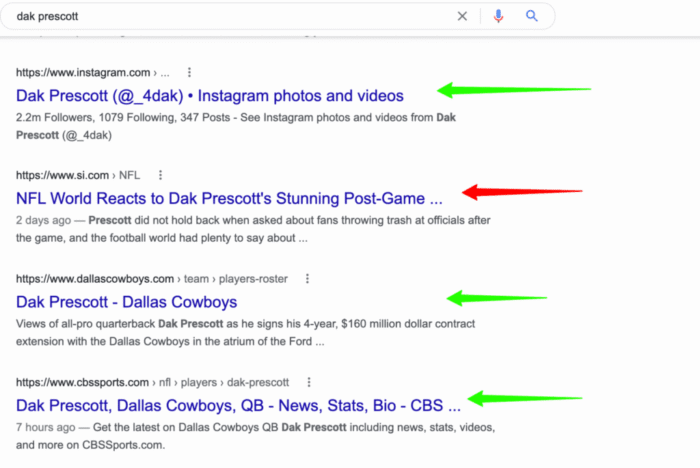
Let’s look at NFL quarterback Dak Prescott as an example. In an interview, Dak suggested that it was okay for fans to be critical of NFL referees. Sports Illustrated took these comments and published a negative article around them. At the time, if you searched Dak’s name, the negative Sports Illustrated article would show up on the first page of Google (the red arrow):
Source: https://gofishdigital.com/blog/how-to-remove-suppress-negative-search-results/
Suppressing this content would mean using the tactics we mentioned above to get the more positive results listed here to overtake the negative article, pushing it down the rankings and off page one. For example, work with your digital PR team to create new articles with Sports Illustrated to outrank the current piece. Alternatively, build links to other Sports Illustrated pieces to help outrank this one.
Promoting Positive Content (PR, Social, Testimonials)
Create more positive “assets” that can rank and spread like customer stories, case studies, founder interviews, press mentions, YouTube videos, and social proof pages. Consistent publishing, combined with smart promotion, makes the positive narrative easier to find—and harder to ignore.
Customer Stories and Case Studies
Don’t just collect testimonials. Interview your best customers. Ask what problem they had, what almost stopped them from buying, and what changed after working with you. Use real numbers when possible.
Publish these as dedicated case study pages. Optimize them around problem-based keywords, not just your brand name. Then promote them in email, link to them from your product pages, and share them across social channels.
Founder Interviews and Thought Leadership
Pitch podcast hosts, industry blogs, and local publications. Offer real insight, not a sales pitch. When the interview goes live, embed it on your site. Create a recap post. Turn key quotes into short-form social clips.
One interview can become five or six pieces of content if you repurpose it properly.
Press Mentions and PR Wins
If you land media coverage, don’t let it sit on someone else’s site. Create a “Press” page. Link to each mention. Add context about why it matters.
You can also proactively pitch stories. Tie your company to trending industry data, original research, or a strong founder story. Journalists need angles. Give them one.
YouTube and Video Content
Video ranks. A lot of reputation-driven searches surface YouTube results.
Create videos that answer branded queries directly:
- “Is [Your Company] legit?”
- “How does [Your Product] work?”
- “Customer review of [Your Brand]”
Optimize titles, descriptions, and tags. Embed those videos into related blog posts to strengthen both assets.
Social Proof Pages
Build a dedicated reviews page on your site. Pull in testimonials, screenshots, awards, and certifications. Structure it clearly. Add internal links from high-traffic pages.
Then promote it. Link to it in proposals. Add it to your email signature. Use it in retargeting campaigns.
Here’s the key: publishing isn’t enough.
Distribute every asset:
- Share it with your email list
- Run paid amplification on high-performing pieces
- Repurpose it into short-form clips
- Link to it internally from relevant content
When you consistently create and promote positive assets, you control more of what shows up in search results. Over time, that positive narrative becomes easier to find and much harder to ignore.
How to Handle Reviews and Mentions
Reviews and brand mentions are public receipts. You don’t get to control what people post, but you do control how you show up after they post it. That’s why a real strategy matters. One sloppy reply can turn a one-star review into a screenshot that lives forever.
Keep Your Tone Calm and Human
Write like a real person, not a legal department. Stay calm. Don’t argue. Don’t blame the customer. Even if they’re wrong, your job is to look reasonable to the next person reading the thread. A simple “Thanks for flagging this—here’s what we can do” goes further than a paragraph of defense.
Respond Fast (Google and Yelp Reward Speed)
Speed signals that you’re paying attention. Set up alerts for new reviews and mentions, and assign an owner internally (support, marketing, or location managers). Same-day responses are ideal for high-visibility platforms like Google Business Profile and Yelp, where people are deciding in minutes.
Handle Negative Reviews the Right Way
Apologize when the issue is real: delays, billing mistakes, poor service, broken products, etc. Own it and explain the next step.
Take it offline when you need personal details or a back-and-forth: “Can you email us at [support] with your order number so we can fix this?”
If the review is abusive, spammy, or clearly fake, keep your reply short, and report it through the platform.
Turn Positive Reviews Into Marketing Assets
Don’t let five-star feedback just sit there. Screenshot it for social, add it to landing pages, pull quotes into sales decks, and turn longer customer testimonials and reviews into mini case studies. This is also where you can build a repeatable system by embedding easy ways to collect testimonials into your process.
Online forms and phone surveys are popular ways to collect reviews but make sure you time them correctly. You want to ask for a testimonial when your customer’s positive feelings toward your brand are at their highest. For realtors, this may be at the closing table after their clients have just signed to buy the home of their dreams. For a contractor, it might be right after he solved a nagging home improvement problem for his client. Look at your overall process and determine when your customers are happiest. That’s your opportunity to ask for a testimonial. Then, reuse the content whenever possible.
What to Do if Your Company Is Subjected to an Online Reputation Smear Campaign
The first thing most companies wonder is, “Can we call the cops?” I get it; being unfairly targeted feels illegal, but in most cases, online comments are not a legal matter.
Article 19 of The Universal Declaration of Human Rights states that:
“Everyone has the right to freedom of opinion and expression; this right includes freedom to hold opinions without interference and to seek, receive and impart information and ideas through any media and regardless of frontiers.”
Everyone has the right to express their voice about your brand. There are, however, certain boundaries that need to be respected. Some of the negative content online actually is illegal. Why?
- It uses defamatory language
- It reports false information
- It is aimed at damaging the company’s reputation
How do you react to all of this? How do you defend yourself or your company from this kind of illegal behavior?
Depending on the scope of the problem, there are several paths that you can pursue to restore your online reputation:
- Aggressive SEO: Suppressing negative search results (like we talked about earlier) is one of the first things that you or your online reputation management company should do. We talked about some of the best tactics, but the main goal is to devise a search marketing strategy to increase the rankings of positive content, whether owned by you or third parties. The search engine landscape is too important to be ignored, and it is the first step in restoring your image.
- Review Removal: Did a user claim something false about your company? Is that review clearly aimed at destroying your reputation rather than providing feedback? Does it contain improper language? You may have grounds for legal action and removal if so.
- Use owned media to control the narrative: Publish a clear, factual response on your blog, issue a press release if warranted, and create short video content that explains the truth in plain English. Then distribute it across social and email.
- Earn trust signals from reputable sites: Get featured on authoritative publications and industry sites. Those mentions plus high-quality backlinks help your positive pages outrank the negative content in search.
- Plan for LLM visibility: Publish a single “facts” page with common FAQs, add basic schema (Organization/FAQ), keep your about/press pages current, making sure the tone and info align with other online profiles (LinkedIn, Google Business Profile, key directories). The more consistent, authoritative sources you have, the less likely AI answers are to repeat the negative sentiment.
You usually can’t “delete” bad content from the web, but you can bury it by flooding page one with stronger, more credible assets that Google and customers trust more.
How to Build an Online Reputation Management Strategy
Your online reputation is your reputation. In the digital era, nothing protects your brand from criticism. This is good from a freedom of speech perspective, but bad if your company has been defamed and attacked.
To help you stay on top of your reputation, here are six practical tips that sum up what we have covered in this guide. The world of brand reputation will change in the coming years, but following these simple tips will help you maintain a good image.
1. Proactively Build Your Reputation
Online reputation management is easier when you’re not always playing defense. Step one is building credibility so customers (and Google) trust you by default. Google calls this “E-E-A-T,” which stands for “experience, expertise, authority, and trust.”
Publish helpful content on a cadence you can sustain. Answer questions buyers Google before they convert: pricing, comparisons, “best for” use cases, FAQs, and common mistakes. This demonstrates expertise and gives search engines more quality pages to rank.
Make proof obvious. Add customer testimonials to your homepage, product/service pages, and pricing page. After a clear win (great delivery, successful onboarding, resolved ticket), ask satisfied customers to leave a review while the moment is fresh.
Boost authority with press. Even small hits like local news, niche blogs, podcasts, partner newsletters have value.
Stay active on social in a real way: share behind-the-scenes photos, customer stories, or quick tips, and respond like a human. Do this consistently, and negative mentions will get less attention while trust compounds over time.
2.Start With a Simple Reputation Audit
Before you “fix” anything, you need a baseline. Here’s a quick audit you can do in 20 minutes.
- Open an incognito/private window (so results aren’t personalized).
- Google your brand name, plus common variations: “Brand + reviews,” “Brand + pricing,” “Brand + scam,” and your founder/CEO name if relevant.
- Scan the first page closely. What shows up? Your website pages, third-party articles, Reddit threads, forum posts, or old press?
- Check review platforms where decisions happen fast: Google reviews, Yelp (if you’re local), and Trustpilot (common for ecommerce/SaaS). Look at the overall rating and the most recent 10 reviews.
- Search social platforms for brand mentions and complaints (X/Twitter, LinkedIn, TikTok, Instagram comments).
For monitoring, start simple: Google Alerts for your brand and key people. If you want more coverage, tools like Mention can pull in social and web mentions.
Pro tip: Take screenshots and track your findings in a spreadsheet to measure improvement over time.
3. Set Clear Goals for Your Online Reputation
ORM only works when you know what you’re aiming for. Otherwise, you’re just reacting to whatever pops up this week. Start by defining what “better” actually means for your business, then measure it.
Here are common goals that are specific (and realistic):
- Get more positive reviews on Google, Yelp, or Trustpilot to increase trust and conversions.
- Reduce one-star feedback by spotting repeat complaints like shipping delays, support waiting times, or billing issues, and fixing the root cause.
- Improve your average star rating (for example, from 3.8 to 4.3) by building a steady review-generation habit.
- Bury negative search results by pushing stronger, more relevant pages to the top of the SERP (your site pages, PR, social profiles, and fresh content).
The key thing: ORM isn’t just about damage control. Done right, it’s a proactive trust-building system with more proof, better visibility, and fewer surprises.
Pick 1–3 goals and tie each one to a metric you can track, like review volume per month, average rating, response time to reviews, share of page-one search results you control, or suppression of negative search results. If it’s not measurable, it’s not a goal; it’s a wish.
4. Assign Ownership Across Your Team
ORM falls apart when it’s “everyone’s job.” Make it someone’s job and designate a clear backup, so reviews don’t sit for a week and mentions don’t get missed.
Who Usually Owns ORM?
ORM is very much a team effort for an organization, but different departments tend to specialize in different areas. Here’s a quick breakdown on what duties generally go to what professionals.
- Marketing: Monitor search results, brand content, testimonials, press, social proof
- Support/Customer Success: Review responses, issue resolution, patterns in complaints
- Social team: Review and respond to DMs, comments, tagged posts, influencer mentions
- PR/Comms: Send out media requests, journalist outreach, manage any crisis responses
You don’t need a big team. You need a clear chain of command.
Create a Simple Response Playbook
Write a short playbook with:
- tone rules (calm, non-defensive, human)
- response time targets (same day for Google/Yelp)
- when to apologize publicly vs. move it offline
- templates for common situations (shipping delay, billing issue, fake review, praise)
Assign Specific Owners For 3 Areas
- Monitoring tools: who checks alerts daily and flags issues
- Responding to reviews: who replies, who escalates, and who closes the loop
- Publishing positive content: who collects wins and turns them into posts, testimonials, and case studies
When ownership is clear, your reputation becomes a system—not a scramble.
6. Track Progress with Real Metrics
If you don’t measure your reputation, you’ll end up guessing, and guessing is how small issues become big ones. The goal is to spot trends early and make smarter decisions month to month.
Start with a few KPIs that actually reflect trust:
- Average review score (by platform and location, if relevant)
- Number of new reviews per month (volume matters as much as rating)
- Brand sentiment (are mentions trending more positive, neutral, or negative?)
Then set up a regular cadence to review what changed, what caused it, and what to do next. Most ORM platforms include reporting. If you’re early-stage, a custom Google Sheet can be used to track ratings, count reviews, measure response times, and identify any “top complaints” themes.
The most important part: don’t just track. Adjust. If billing complaints spike, fix the process. Metrics are only useful when they drive action.
FAQs
What is online reputation management?
Online reputation management (ORM) is the process of shaping how your brand is perceived online. It encompasses monitoring reviews and brand mentions, responding to feedback, improving what shows up on Google’s page one, and promoting trust-building content like testimonials and press. The goal isn’t to “hide” reality—it’s to earn trust and make sure accurate, positive info is easy to find.
Why is online reputation management important?
Trust influence conversions, so a single bad review or negative search result can kill a sale before you ever get a chance to pitch. ORM helps you catch issues early, respond fast, and build credibility so that small problems don’t spiral. It also improves SEO, click-through rates, and customer confidence, especially when buyers compare you side by side with competitors.
How do you do online reputation management?
Start by auditing what shows up when you Google your brand (in incognito mode). Then set up monitoring (Google Alerts, Mention, Brand24). Respond quickly to reviews with a calm, human tone. Fix recurring issues driving negative feedback. Publish helpful content and add testimonials to key pages. If negative results rank, create stronger pages and distribute them so they outrank the negatives.
How do you improve online reputation management?
Systematize it. Set one to three goals (rating, review volume, response time, page-one results) and track them monthly. Create a response playbook and assign owners for monitoring, replying, and publishing positive content. Ask happy customers for reviews at the right moment, and turn your best reviews into testimonials, case studies, and social proof. Then adjust based on patterns in complaints and sentiment.
Conclusion
Managing your online reputation starts with listening to what your customers have to say and finding ways to connect with them. Actions like replying to online criticism and building an SEO strategy are crucial, but they might not be enough to protect your brand from smear campaigns. As business continues, you may want to consider ways to strengthen your reputation further, like launching a brand Wikipedia page. If those steps don’t fix the issue, those cases, it might be time to get professional help.